

Hi there, readers! In this article, we'll talk about what a valve and how it works. Describe the many kinds of valves, along with examples of how they are used.
Let's go right to talking about what a valve is.

What is a Valve?
A valve is, to put it simply, an internal part that, for a variety of reasons, opens, closes, or partly stops the flow of fluid in a system. As a result, the valves' function in a system is to control the flow and pressure of fluid.
In order to regulate the flow of liquids, vapors, or gases in pipe systems, valves are essential parts. They provide a useful means of controlling the amount and pressure of gases or liquids that flow through pipes.
Before installing any kind of valve in a piping system, it is crucial to know which kind is needed for that particular purpose.
We'll go over some of the most often used valve types in pipelines and discuss how to utilize them for certain purposes in this blog article.
Continue reading to find out more about valves.
Types of Valves
Depending on the needs, the following types of valves are used in pipelines. Up to 20–30% of the total cost of the pipe system may be attributed to the cost of the valves. Also, the price of a certain kind and size of valve might differ by 100%. This means that for the same purpose, if you go with a ball valve rather than a butterfly valve. You might have to pay more for it. Therefore, the operation and economy of the process plants depend on the choice of valves.
The major kinds of valves are as follows:
- Gate Valve
- Globe Valve
- Ball valve
- Butterfly Valve
- Check Valve
- Plug Valve
- Needle Valve
- Diaphragm Valve
- Relief Or Pressure Relief Valve
- Piston Valve
- Poppet Valve
- Rotary Valve
- Thermostatic Mixing Valve
- Pressure Regulating Valve
- Slide Valve
Also Read: The Most Important Parts of Car Engine Explained
#1 Gate Valve
 |
Gate Valve |
It is a valve that opens when a barrier or gate is moved to allow the fluid to pass through. This valve is occasionally referred to as a sluice valve. Its mechanism involves the disc (either a single or double disc) moving inside its body back and forth. It functions as a method of shutting down. Double disc valve shutoff is nice.
Generally, gate valve stems can be either rising or non-rising. There are many different sizes of gate valves, ranging from 12 mm to 300 mm and even bigger. When the gate valves are completely open along the pipe axis, they scarcely impede fluid flow because of their compact design.
Gate valves have a low pressure drop, are reasonably priced, and are lightweight. These valves have a maximum temperature of 675 °C and a maximum pressure of 20 kg/cm2. Among the materials that may be used to construct gate valves are alloys of nickel, bronze, ductile iron, carbon steel, stainless steel, and cast iron.
Gate valves come in a variety of forms, such as the following:
- Solid Wedge Gate
- Flexible Wedge Gate
- Split wedge or Parallel disks Gate
- OS & Y Gate, or (Rising Stem) of gate valves
- Non-rising Stem Gate Valve or Insider Screw Valve
#1 Solid Wedge Gate
Solid wedge disc valves are quite common. Due to their exceptional simplicity and strength, they are often utilized in plants. This valve is very flexible to install and may be done wherever. This is appropriate for most liquids. It is also applicable to turbulent flows
#2 Flexible Wedge Gate
A solid disk that is one piece with a cut along the edge is what makes up a flexible wedge gate valve. This valve comes in a variety of sizes, shapes, and depths.
The solid wedge problem is made simpler by using the flexible wedge concept. Both the leak tightness and the seat alignment are enhanced by this valve design.
#3 Split wedge or Parallel disks Gate
The problems with both flexible wedge gates and solid disc wedges are addressed by split wedges. It consists of two parallel-connected disks joined together.
It is typically spring-loaded and permanently attached to the gate seat; a parallel split disk variant is also available. These are used in low- and high-temperature control of noncondensing gases and liquids.
#4 OS & Y Gate, or (Rising Stem) of gate valves
Other names for OS & Y include exterior screw and yoke and outside stem and yoke. This valve controls the amount of water that fire sprinkler systems get. A gate that opens and closes to regulate the lower into and rise out of valves controls these valves.
#5 Non-rising Stem Gate Valve or Insider Screw Valve
In a non-rising stem type, the stem does not travel higher. There is internal threading on the valve disk. When the stem is turned, this design slides a gate along it like a nut. The picture is visible to you. When this kind of valve is closed, the stem threads are exposed to the flow medium.
#2 Globe Valve
 |
| Globe Valve |
This kind of valve, which has a spherically-shaped body with a fixed ring seat and a moveable plug or disc element, is used to regulate flow in pipelines. Alternatively, a disk or plug that rotates back and forth powers it.
The body's spherical form is alluded to in the name of this valve. It has an interior baffle that splits it in half. The valve can be closed by screwing a moveable stopper into an aperture that serves as a seat.
The valve has three modes of operation: power, manual, and automated. The diameters of globe valves range from 12 mm to 300 mm. The maximum operating pressure and temperature for them are 150 kg/cm2 and 550 C, respectively. Brass, ductile iron, stainless steel, carbon steel, and other corrosion-resistant alloys are used to make globe valves.
There are three different types of globe valves, depending on the type of body:
- Z types
- Y types
- Angle types
#1 Z Type
The Z-type globe valve design is the most basic kind. Inside this globular body's tap is a Z-shaped barrier. The purpose of these valves is to lessen issues with manufacture, installation, and maintenance. Z-type valves don't allow for pressure loss, hence they have to be throttled.
#2 Y Type
Y-type valves were created to address the high-pressure drop problem with Z-type valves. Therefore, the Y-type, where seats are tilted at a 45° angle to the pipe's axis, is used to reduce the Z-type problem. These valves are therefore utilized in high pressure applications as well as several additional reproving services.
#3 Type of Angle
These valves don't require an elbow or an additional pipe weld to shift the direction of fluid flow by ninety degrees. A disc in this valve has opened against the rise and fall of the disk. In addition, it may be utilized with varying globe valves to control the slugging effect.

#3 Ball Valve
 |
| Ball Valve |
A ball valve uses a hollow, perforated, rotating ball to control the amount of fluid that passes through it. A ball valve is closed when the handle rotates it 90 degrees, obstructing the flow, and open when its hole matches the flow entrance.
A ball revolves within a two-way globe between robust seats in a ball valve. It requires no lubrication, is compact, and requires little upkeep.
It is available in venture port, reduced, and full designs. To open or close the valve, spin the ball a quarter of a turn. Typically, the ball valve offers inadequate throttling.
They are widely used in sectors that handle chemicals. When a combination of cutoff and throttling is required, it is employed. There are sizes for the valve that range from 6mm to 900mm. It can withstand pressures and temperatures of up to 500 kg/cm and 300 °C, respectively.
There are several kinds of ball valves, such as:
- Floating
- Trunnion Mounted
- 3 Way
- Side entry or split body
- Three-piece body
#1 Floating Ball Valve
In a floating ball valve, the compression of the two elastomeric seats against the ball holds the ball in place. Within the valve body, the ball is allowed to float freely. Examine the area in the image that is highlighted, and keep in mind that when I describe the trunnion-mounted valve, you will see the difference.
#2 Trunnion Mounted
The issue of excessive torque needed by a floating type valve in high-pressure duty can be resolved with a trunnion mounted valve. A short shaft functions similarly to an extension, or trunnion, positioned within the body. This is seen in the picture. Ball and steam function as a single unit in this configuration. Two seats that are either floating or spring-loaded and always in touch with the ball support the ball.
#3, 3 Way Ball Valve
There are three available patterns. Three port types are available: reduced, full, and venturi. The interior diameter of the full-port ball valve and the pipe are the same. This layout permits pigging. Typically, the port in venturi and reduced-port designs is one pipe size smaller than the line size.
The ball-type disc may be fastened within the valve body or it may float freely. A fixed type valve is referred to as a trunnion-mounted valve, whereas a free-floating valve is called a floating type.
#4 Split-Body Ball Valve
In this design, a valve body is divided into two or three body pieces. The bigger body element is bolted together with smaller pieces to hold a ball, seat rings, stem, and other internal components in place.See the image of the floating ball valve for a valve with a split body and two parts. For an example of a split body, three piece type valve, see the figure below.
#4 Butterfly Valve
 |
| Butterfly Valve |
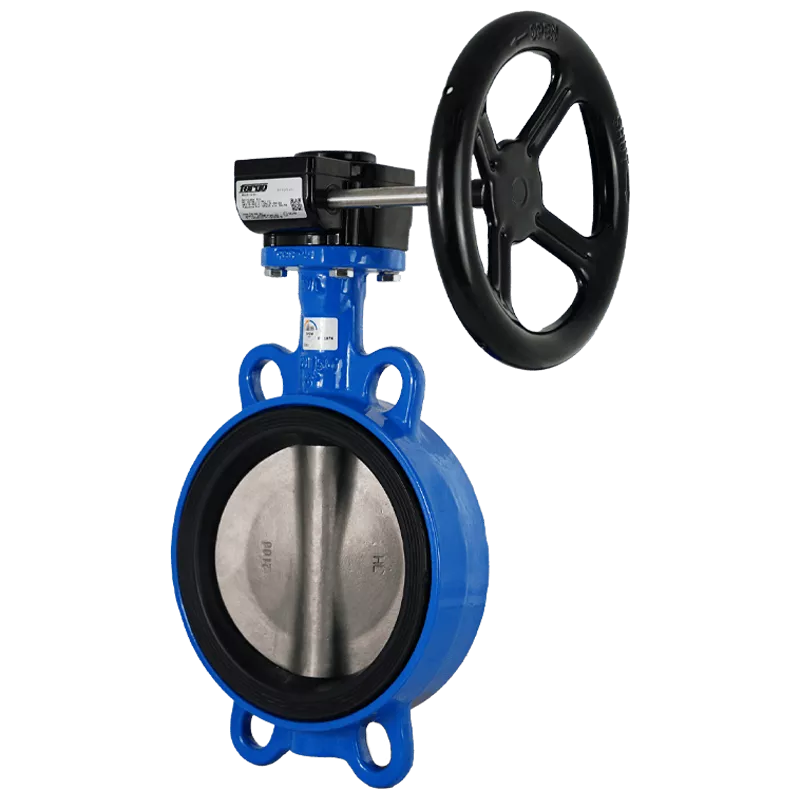
The butterfly valve's regulating element is a disk called a blade, vane, or flapper. This disk allows fluid to circulate and spins both horizontally and vertically. These valves can be utilized for throttling at minor pressure dips or for on/off operation.
These valves stop solids from building up and are cheap and easy to install. There are two types of butterfly valves: screw and wafer. It can be operated manually, electrically, or automatically according on the design.
Butterfly valves have a maximum pressure tolerance of 80 kg/cm2. These valves are available in a wide range of diameters, from 50 mm to 900 mm.
Butterfly valves are useful in water treatment and chemical facilities, among other places, where prompt, accurate judgments are required. They are frequently found in HVAC systems, which must react quickly when the temperature changes or when the ventilation of the air has to be changed.
The types of butterfly valves are as follows:
- Concentric Butterfly
- Eccentric Butterfly
- Wafer Type Butterfly
- Lug Type Butterfly
- Double Flange Butterfly
#1 Concentric Butterfly
The stem axis, disc center, and central body of a concentric butterfly valve are all positioned in the same direction. The concentric center line butterfly valves are easily made and have a straightforward construction. The most popular form of butterfly valve in this category is the rubber-lined concentric butterfly valve.
The concentric butterfly valve's drawback is that because the disc and seat are continually compressed, their resistance to scratches and wear accelerates. The interference fit between the valve disc and liner is essential to the operation of a concentric rubber lined butterfly valve.
#2 Eccentric Butterfly
Industrial valves known as single-eccentric butterfly valves are made to completely open or close a channel for the working liquid that is passing through a pipeline. They may be applied to flow control as well. However, a long-term usage of the valve for control purposes cannot ensure 100% tightness. TDS.
#3 Wafer Type Butterfly
The majority of butterfly valves in the wafer form are designed with four holes that match up with the pipeline that is attached. The valve fits into your pipe construction by clamping between two flanges. Most wafer butterfly valves are compatible with most flange specifications.
Because wafer butterfly valves may control via any position of the disc and are very inexpensive and simple to install in comparison to other types of valves, they are utilized in a wide range of industrial and commercial applications.
#4 Lug Type Butterfly
Steel or ductile iron are common metals used to make lug-style butterfly valves. On the valve flanges, they have threaded tapping lugs for bolt connections. End-of-line service is acceptable for lug-style butterfly valves, although a blind flange is usually advised.
#5 Double Flange Butterfly
With a twofold sealing effect guaranteed by this design, they function better while sealing under high pressure. They are typically employed in harsh environments requiring high pressure ratings and are greater in size.
Also Read: Different Car Sensor Types and Their Purposes
#5 Check Valve
 |
| Check Valve |
It is sometimes called a foot valve or a one-way valve. Usually, this type of valve only permits one direction of flow for liquids or gases.
Because Inconel sheets are strong and resistant to chemicals, they are used in many different industries throughout the world, which is why these valves are manufactured of them.
Check valves are an effective way to control gas flow and pressure in pressure relief systems while also ensuring safety. Both high and low pressure conditions may be tolerated by these valve types. There are horizontal and vertical variants of check valves.
The three different kinds of check valves:
- Lift check valve
- Piston check valve
- Swing check valve.
#1 Lift Check Valve
A ball, piston, or disc is used as a checking mechanism in this valve. It may be mounted vertically or horizontally. Lift check valves are suitable for locations with large pressure drops and little pipes.
#2 Check Valve for Pistons
The piston check valve is operated by the stem. These valves are available in diameters between 6 and 600 mm, and they may be turned by hand or with the help of a motor. They can withstand pressures and temperatures of up to 170 kg/cm2 and 675 °C, respectively.
#3 Swing check valve.
When there are few flow reversals and modest fluid velocities, this valve is used. On the discharge side of pressure relief valves, they are frequently utilized.

#6 Plug Valve
 |
| Plug Valve |
Plug valves are those in which the flow through the valve is adjusted by rotating cylindrical or conically tapered plugs located inside the valve body. Fluid passes through the plugs in plug valves, which feature sideways hollow channels, when the valve opens.
Plug valves are often inexpensive and simple to operate. It also has a huge capacity, is lightweight, and takes up little installation area. Stainless steel, brass, aluminum, and Inconel sheet are among the materials used to make plug valves.
Slurries and pulp handling are two applications for it. A plug valve with one or more apertures can be created to alter the direction of flow. It has the option of being lubricated or not.
Plug valves come in four different types.
- Lubricated Plug
- Non-Lubricated Plug
- Eccentric Plug
- Expanding Plug
#1 Lubricated Plug
Lubricant is used in lubricated plug valves. In order to lower friction and seal ports under pressure between the plug's face and the seat body, a viscosity improver is added to the basic oil in this lubricant.
#2 Non-Lubricated Plug
The non-lubricated plug functions as a wedge (chock) by pressing against a polymeric sleeve with its tapered or cone-shaped body cavity. Plug valves without lubrication are utilized in low-maintenance applications.
#3 Eccentric Plug
Applications requiring a larger seating force and less friction from open to shut employ eccentric plug valves.
#4 Expanding Plug
When double isolation is not required, the expanding plug valve is employed to prevent product contamination. As it moves between the open and closed positions, this valve shields both seals from the flow route.
#7 Needle Valve
 |
| Needle Valve |
The plunger of a needle valve is threaded and has a needle-like form, and it has a small port. It can only usually control a low flow rate, but it does allow for accurate flow control.
Needle valves are very helpful in process piping systems because of their remarkable efficacy in managing high-pressure liquids or gases.
This valve is used for modest, precise flows. Up to 260 C and 650 kg/cm of pressure and temperature, respectively, may be applied to the valve.
Its dimensions are 3 mm to 25 mm. Using needle valves, which regulate the actuation of hydraulic or air fluid, lowers pressure fluctuations.
Utilization
- A needle valve is installed on every field analog instrument to regulate flow entrance since the instruments might be harmed by abrupt pressure-driven fluid surges.
- Needle valves are useful in applications where precise flow changes are needed or when a low flow rate is required, such sampling sites in pipelines, and where the flow must cease gradually.
#8 Diaphragm Valve
 |
| Diaphragm Valve |
Diaphragm valves are essentially made up of a flexible diaphragm and a seat or weir where the diaphragm shuts. The valve body has two or more openings. The valve body might be composed of plastic, metal, wood, or another material, depending on its intended application.
Diaphragm valves come in two varieties: weir type and straight-through type. Weir-type diaphragm valves must have relatively short shut-off and push strokes.
As a result, the diaphragm lasts longer. The diaphragm valve of the straight-through type is capable of handling fibrous suspensions, viscous liquids, and slurries.
Neoprene, buna, or rubber make up the diaphragm. Sizes ranging from 3 mm to 600 mm are offered for it. It is resistant to temperatures as high as 2200 Cand pressures as high as 20 kg/cm2.
Utilization
Ideal applications for diaphragm valves include:
- Chemical compatibility may be selected for both the diaphragm and body materials in corrosive applications. For example, bases and acids.
- Applications involving abrasion, where the diaphragm may be readily changed as it wears out and the body lining can be made to tolerate abrasion.
- Liquids entrained solids because the diaphragm can produce a positive seal by sealing around any solids entrained.
- Slurries, since the diaphragm can produce a good seal by sealing around entrained particles
#9 Relief Or Pressure Relief Valve
 |
| Relief Or Pressure Relief Valve |
This kind of valve regulates or restricts the pressure within a system; if the pressure is too high, it may cause an explosion, fire, process disruption, or instrument failure.
It prevents damage, lessens equipment failure, and controls pressure in a system that has a release point. Relief valves include manual and automated modes of operation.
In many commercial and industrial applications, these valves are a vital safety element. Using relief valves has the disadvantage that they might not always be able to control temperature spikes or overpressure in the system.
The types of pressure relief valves are as follows:
- Spring-loaded pressure relief
- Safety relief
- Pilot operated pressure relief
- Power actuated pressure relief
- Balanced Bellows and Balanced Piston valves
#1 Spring-loaded pressure relief
Direct spring-loaded pressure relief valves use the mechanical force of a spring to keep the valve in a close position until system pressure rises enough to counteract the spring's mechanical force.
When the diaphragm is forced upward by the valve's outlet pressure, the valve closes. As the valve's set point is reached, the spring pressure pushes the valve stem downward, opening the valve since it is stronger than the outlet pressure.
#2 Safety relief
The purpose of relief systems is to reduce the discrepancy between the equipment pressure within and outside. When upset (pressure) situations arise in a process plant, the relief valves shield instrumentation, piping systems, and mechanical equipment from harm.
#3 Pilot operated pressure relief
The input and outlet ports of the main valve are controlled
by pilot-operated valves, which are pressure relief valves. Though they are the
best substitute for spring-loaded valves in terms of achieving the maximum
pressure and capacity, they are identical to them. Excellent overpressure
protection performance is provided by these valves.
#4 Power actuated pressure relief
Power-actuated safety relief valves: A power source, such as electricity, steam, or water (hydraulic), completely controls the movement of the valve to open or close. The valve can release air into the atmosphere or into a lower-pressure container. The circumstances downstream may have an impact on the discharge capacity.
#5 Balanced Bellows and Balanced Piston valves
The forces operating on the disc are balanced since the disc area that extends beyond the bellows and the opposing disc area are equal. As a result, the backpressure has minimal impact on the valve opening pressure.
Systems needing a regulating valve that may be adjusted are intended for the balanced-piston relief valve Series WFCS/CT. In order to regulate pressure in a hydraulic circuit to a specified maximum, applications needing an adjustable regulating valve are designed to use the Series WFCS/CT balanced-piston relief valve.
#10 Piston Valve
 |
| Piston Valve |
A piston valve regulates the flow of a fluid via a tube or pipe by means of the linear motion of a piston inside a chamber or cylinder. They regulate when gas, steam, and other fluid services are switched on and off according on how fully open or closed they are.
These valves are very good at controlling. It may also be utilized for liquids containing solid particles since the piston opens and closes by sealing packs. They also function well with gaseous liquids.
The piston valve has a complete port composed of forged steel, a maximum working temperature of 427°C/800°F, and a maximum operating pressure of 135 bar/1973 psi.
#11 Poppet Valve
 |
| Poppet Valve |
In addition to regulating the amount and timing of gas or vapor entering or leaving an engine, this valve has several other applications.
It is composed of an opening or open-ended chamber with a cross-section that is usually round or oval, and a plug that is usually fashioned like a disc at the end of a shaft called a valve stem.
The working end of this plug, known as the valve face, is normally ground at a 45° angle to seal against a valve seat that is ground into the rim of the chamber. To maintain the shaft's center, the valve travels through a valve guide.
Poppet valves are superior to other engine valve types in a number of ways, such as quicker reaction times, increased performance, less friction, reduced sensitivity to contaminants, and lower Costs.
#12 Rotary Valve
 |
| Rotary Valve |
This valve rotates one or more passageways in a transverse plug to regulate the flow of liquid or gas via the connecting pipes. A stopcock is the most basic kind of rotary valve.
Its benefits include far higher rpm and compression ratios, which translate into more power; a lighter and more compact cylinder head; and less complexity, which translates into increased dependability and less expenses.
These valves control the steam and exhaust ports of steam engines and are mainly found in the Corliss steam engine. Brass instruments can also have their pitch altered with its help. The two-stroke and four-stroke engines are the ones that typically have these valves.
#13 Thermostatic Mixing Valve
 |
| Thermostatic Mixing valve |
In order to prevent burning and maintain constant, safe shower and bath output temperatures, this valve blends hot and cold water.
Controlling thermostatic mixing valves is often done using a wax thermostat. Additionally, they promptly shut off in the case of a hot or cold supply failure to avoid heatstroke or scorching.
By keeping the temperature at a set level, a TMV lets you enjoy leisurely showers without worrying about getting burned or freezing. Installing TMVs might be more expensive than installing regular showers or faucets. Like every mechanical device, TMVs have a limited lifespan.
The three primary types of these water temperature control devices are Point-of-Use, Group Control, and Heat Source.
#14 Pressure Regulating Valve
 |
| Pressure Regulating Valve |
A pressure regulating valve uses the regulated pressure's negative feedback to control the fluid's pressure. These are employed in the regulation of gas and liquid flow.
They can be separate devices with flow valves, controllers, and pressure sensors, or they can be integrated devices that house a sensor, restrictor, and pressure setting in one body.
Pressure reduction regulators and back-pressure regulators are the two types of pressure controlling valves.
By using pressure-reducing regulators, a fluid's input pressure may be brought down to the required level at its output. By opening to let flow when the intake pressure rises over the set point, back-pressure regulators maintain the set pressure in the inlet.
#15 Slide Valve
 |
| Slide Valve |
The rectilinear slide valve controls the amount of steam that enters and exits the cylinder of a steam engine.
Because the stem or tube linking the upper and lower valves of this valve was hollow and the valves were connected by a rod or spindle, the upper end of the cylinder served as an induction pipe. Thus, the work of four valves might be completed by two valves.
This valve has a short overall length, is lightweight, and lacks a wedging motion. Sliding valves are easy to power. The primary steam and feed lines in the power sector employ large-size slide valves to separate various plant components.
The Conclusive Thought
That is all. I appreciate you reading. I think I've covered everything there is to know about "Types of Valves."It would be incredibly helpful if you could let me know anything I missed or if you have any questions about anything I wrote.
Also Read:





0 Comments